
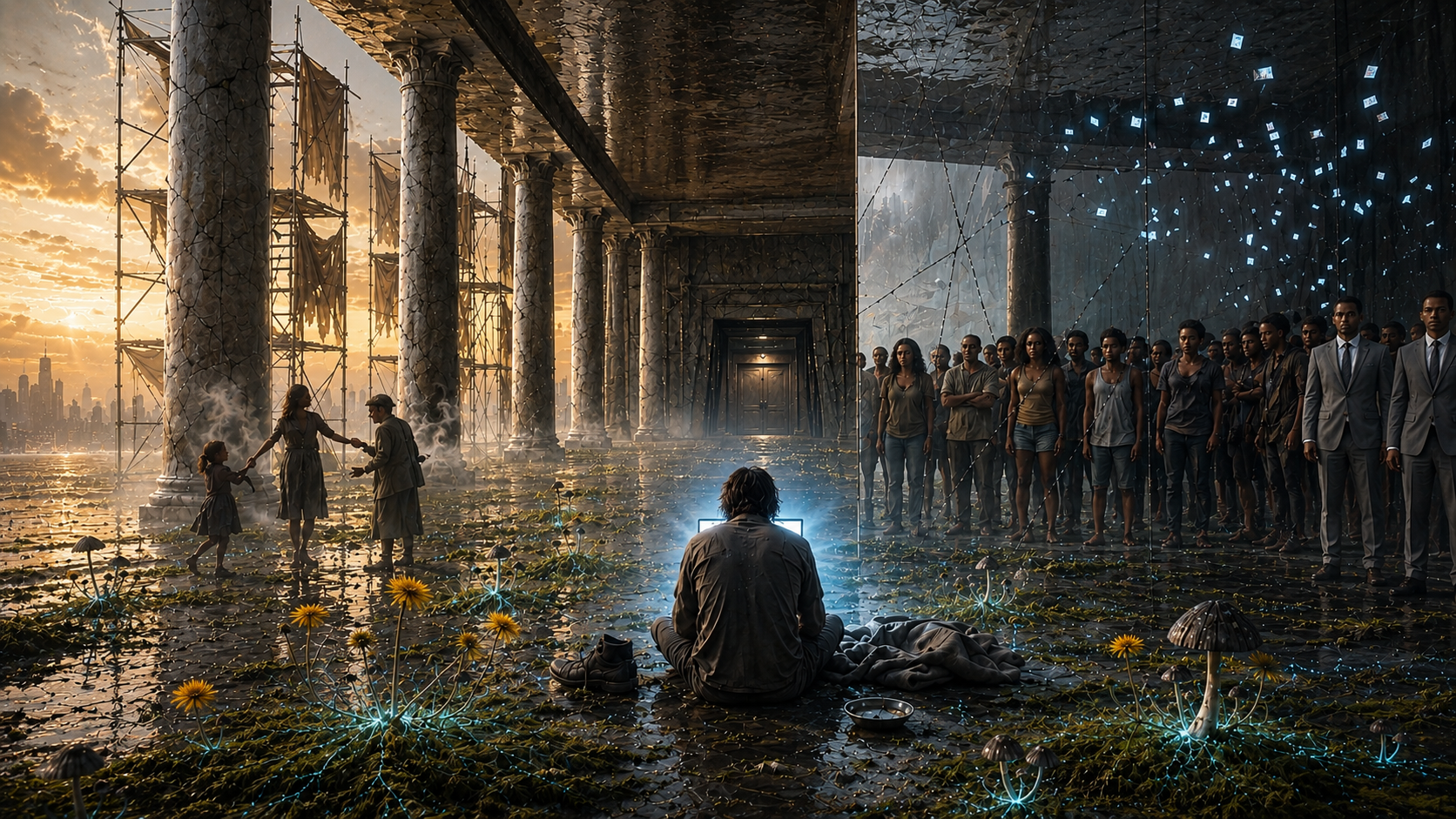
Artwork provided by the author · Revista Fórum
The owners of power and the others: Faoro and Fonseca in the same mirror
Raymundo Faoro described the owners; Rubem Fonseca, who pays for them. Two writers, the same Brazil seen from opposite sides of the mirror.

O mesmo país, dos dois lados do espelho
The feed scaled both - The estate is now digital.
“They owe me food, pussy, blanket, shoes, house, car, watch, teeth, they owe me.” Rubem Fonseca's Collector knew exactly what was owed to him – and had no shame in naming it. Fonseca wrote this in 1979. Raymundo Faoro, twenty years earlier, had accurately described who should: the elite that has governed Brazil for six centuries, which appropriates the State as its own patrimony and calls it public administration. One described the owners. The other described who pays for them. Two writers, different decades, the same country seen from opposite sides of the same mirror.
Faoro and Fonseca were never read together. They should. What one diagnosed as a structure, the other narrated as a consequence – and the consequence, in Fonseca, is not abstract: it has the name of a tooth pulled out without anesthesia, of hatred that is fueled when anger subsides. "I sit in front of the television to increase my hatred. When my anger is decreasing and I lose the desire to collect what is owed to me, I sit in front of the television and in a short time my hatred returns." Today television is the feed. The hate continues. The structure that Faoro described as well. The account remains open – and is now managed using an algorithm.
Six centuries of structure
On the centenary of Raymundo Faoro – and also of Rubem Fonseca –, the Brazilian public debate devoted little attention to authors who remain extraordinarily current. The structure analyzed by Faoro has not disappeared. He just started to operate through instruments that he could not have known – algorithms, platforms, microtargeting and artificial intelligence -, without abandoning the logic of concentration of power that his work described with remarkable precision.
Faoro takes the concept of estate from Weber and reconfigures it for Brazil. The estate is not a social class – the classes negotiate, the estates govern. It is a layer defined by honor and belonging to a group that perceives itself as qualified to exercise power. Its members think and act knowing that they are part of the same high circle – and act accordingly.
"The estate presupposes social distance and strives to achieve exclusive material and spiritual advantages. The closure of the community leads to the appropriation of economic opportunities, which lead, at the extreme point, to monopolies of profitable activities and public positions." – Faoro, The Owners of Power
The origin lies in the absence of feudalism in Portugal. Unlike Western Europe, where power emanated from land ownership and progressively generated an autonomous bourgeoisie, Portugal built a State that precedes and organizes the economy. The English colonies in North America received another model: colonists who needed to self-organize, without a large providing metropolis, which generated a culture of market, contract and civil autonomy. Brazil never had this space – the State always arrived before civil society. From hereditary captaincies to the Federal Senate, the same logic: those inside distribute, those outside wait. And corruption is not a deviation from the system: it is the system operating normally.
Debt on the other side of the mirror
The Fonseca Collector has no name – his role is his identity. You know exactly what is owed to you. You know who owes it. And it will charge. Between the legislative process that does not reveal its foundations and the Collector who knows exactly what is owed to him, there is Brazil: on the one hand, the machine that manages subjects without listening to them; on the other, those who no longer expect to be heard. The story ends open-ended – without a moralistic outcome. Fonseca does not deliver the resolution. He delivers the diagnosis: “I know that if everyone who was fucked up did like me, the world would be better and fairer.” It's not optimism. This is what happens when debt accumulates long enough without being recognized.
My father's friend's friend
In April 2019, Crusoé magazine published a report based on a document from Operation Lava Jato. In it, contractor Marcelo Odebrecht responded to a request from the Federal Police about the identity of a character mentioned in an email as “a friend of my father's friend”. Odebrecht responded: it was Dias Toffoli, then president of the STF. The report was censored by Alexandre de Moraes – who ordered its immediate removal, summoned the journalists to testify within 72 hours and imposed a fine of R$100,000 per day. The STF censured itself, in favor of itself.
“Friend of my father’s friend” – the expression is not vocabulary exclusive to the institutional leadership. It is the language of the establishment in all its layers: from the Supreme Court to the marginal faction, from public contracts to the mouth of smoke, from the ministerial office to the housing complex. What changes is the object of the transaction – not the logic that organizes it. Faoro had named this: personal loyalty that replaces impersonal public criteria, the network of favors that operates outside the normative framework that the estate itself builds. Corruption is no exception – it is the vernacular.
The feed scaled the characteristics of both sides without changing the structure: the most shameless Owners, the Collectors with the most accumulated hate. But direct confrontation does not happen – because the system took care to blur the causal link. The subject feels the hatred but cannot clearly identify the object. Polarization serves the establishment: while the Collectors dispute among themselves which spectrum is more legitimate, the real debt – Faoro's, Fonseca's – remains unpaid.
Specters, retrotopia and the shifting debt
Philosopher Jacques Derrida coined the concept of “hantologie” (hauntology): the present inhabited by ghosts from the past that have not been properly buried nor properly incorporated – specters that haunt without ever being completely present. The feed is a spectrum production machine: it selects which ghosts to feed, which to circulate as identity fuel.
In Retrotopia (2017), Zygmunt Bauman named the complementary phenomenon: when the future loses credibility, the past becomes destiny. Modern utopias always point forward – a better world to be built. What the 21st century produced was an inversion: nostalgia as a political project, the past recovered as a promise. The feed operates in both dimensions simultaneously: it produces spectrums of stories that were not lived and projects to recover a past that never existed exactly like that. Hauntology fragments the Collectors into identity disputes; retrotopia orients them to the past. Fonseca's concrete debt dissolves into performative identity – and the real bill remains unpaid.
A people who begin to identify with the history of another people via microtargeting end up demanding reparation for a pain they did not experience. The state finances this demand because it does not threaten anything concrete. Brazil already has its own spectrum to inhabit – more radical than any imported narrative. Darcy Ribeiro called it a new people: the traumatic emergence of something unprecedented that does not descend from any original people. Édouard Glissant called it “creolization”: something radically new emerges, and this newness does not belong to either party. It is the sovereignty that the feed cannot fully capture – and that Caetano Veloso named in O Quereres: “Where you want Leblon, I am Pernambuco / And where you want a eunuch, stallion.” The Brazil that does not fit into any rule, that responds to any adaptation project with what was not requested. The “brute flower of desire” that the estate cannot completely manage.
Hauntology in electronic music In the early 2000s, the expression hauntology began to identify a segment of electronic music marked by echoes, noise, degraded recordings and the feeling of a time haunted by memories and unfulfilled futures. Due to aesthetic affinity, the track “Reversed Beginning” (2018), by Luwaks, evokes this experience by suggesting a time that seems to advance and return at the same moment.
What grows underground
In Germinal, Zola follows a miners' strike that fails. The mine floods. Workers die. And in the last paragraph, something begins to germinate beneath the ground – in seeds that no defeat can stop. What makes this germination possible, invisible on the surface, are mycelia: the underground networks of fungi that sustain entire ecosystems without receiving recognition. The fungus is the mycelium – not the mushroom you see, but the network that grows in the darkness. Chernobyl's black fungus captures ionizing radiation and converts it into energy – in a process called radiosynthesis. It cannot survive despite radiation: radiation is its source of life. Chernobyl is not an obstacle – it is a substrate. It is by this logic that any process of democratic regeneration operates: not despite deliberative collapse and technopolitical capture – but through them.
Martinho da Vila's Roda Ciranda names the temporality that this requires – as Nêgo Bispo has always signaled: beginning, middle and beginning. “The wheel is meant to turn / Of the life that turns.” Three generations in the same movement: the girl, the old woman, the child. The inner, continuous time necessary for the formation of collective consciousness – what Bergson called “durée”, incompatible with the instantaneous rhythm of the feed – is exactly what the democratic process would need to cultivate.
The Cobrador de Fonseca ends in an open question. The debt was not paid off. But the character discovered something: "My hatred is different now. I have a mission." Between the Collector who names the debt and the Owners who manage it with “my father's friend's friend”, there is a space that the feed occupies with specters and retrotopias.
There is co-emergence in the regeneration of the public space that the digital panopticon degraded – and of the politics that, as Habermas evoked, used to inhabit it. Between worlds, between times – without the certainty of utopia, without the illusion of retrotopia, without the paralysis of nostalgia. The mycelium grows in between.