
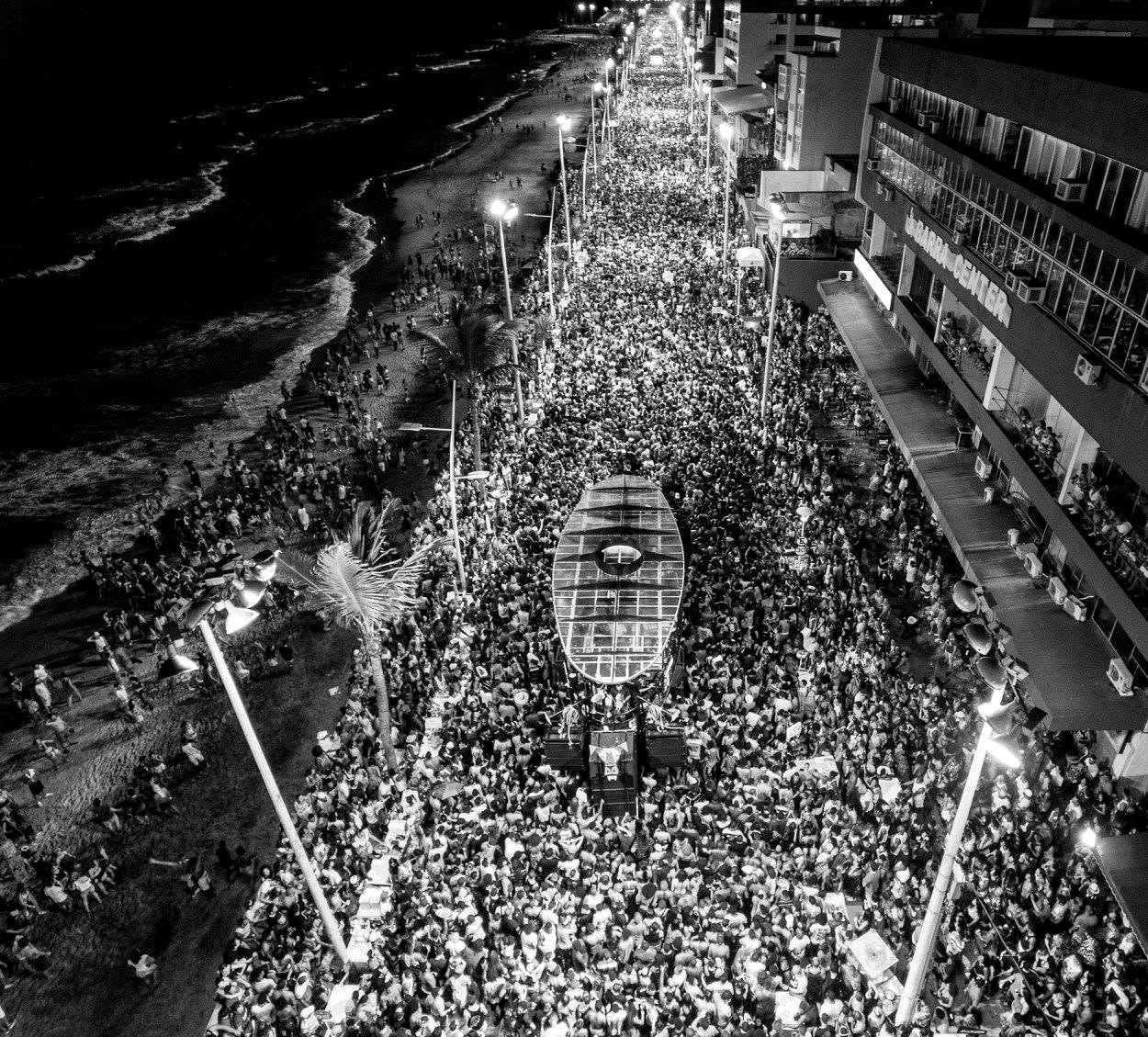
Photo: Máquina de Loucos · Navio Pirata (BaianaSystem) · Revista Fórum
Bahia or Berlin: Tim Ingold's ear-body between Berghain and BaianaSystem
Tim Ingold's ear-body co-emerges in Berlin and in Bahia — the refusal of digital hyperconnection as the condition for presence without prosthesis, without a screen between the body and the event.

The Pause
In Berlin and in Bahia, with no direct relation between them, two phenomena co-emerge as a response to the same exhaustion: the refusal of digital hyperconnection as the condition for presence without prosthesis, without a medium, without a screen between the body and the event. Berghain bans phones on the dance floor. BaianaSystem's Pirate Ship moves crowds through the streets of Salvador in a body that lets itself be captured by no frame. In both cases, the Pause is just that: the instant in which to human ceases to be a state and becomes a verb again.
It is only because we listen that the world can speak to us, in voices of its own. And it is in our ears — and only there — that the creaking of trees, the howling of the wind and the rolling of thunder come to life. In these same ears, these voices join together in chorus, moving us to respond in speech and song, in the resonant idioms of poetry and myth. [...] And what if we were to seek here the roots of language — in responsiveness to possession, and in the responsibility that comes with it of holding the choral counterpoint in some kind of harmony? This responsibility does not make the human dominant, but vulnerable. And it is in this vulnerability that its exceptionality lies.
Berghain and Pirate Ship
At first glance, little seems to bring Berghain, in Berlin, close to BaianaSystem and its Pirate Ship, which crosses the streets of Salvador during carnival. One occupies a former power plant turned electronic-music space. The other moves through the city accompanied by a crowd. The soundscapes are distinct. So are the histories. And yet both produce experiences that do not easily allow themselves to be reduced to their representation.
At Berghain, the line is part of the event. Hours of waiting with no guarantee of entry precede the crossing of a door beyond which the cameras of phones are covered and the production of images ceases to occupy a central position. For a few hours, the experience ceases to be organized by the permanent logic of recording. Attention returns to the event.
On the Pirate Ship, the event is not located at a fixed point. It runs through the city and the crowd moves with it. At certain moments, a clearing opens up within the human flow. A young man spins, whips his hair, turns upon himself. The space closes again. The circle reappears. It dissolves once more. Bodies advance, retreat, cross one another and reorganize continuously. Nothing seems to obey a centralized choreography and, even so, the whole acquires a rhythm, a direction and a consistency of its own.
The affinity
The affinity between Berghain and BaianaSystem lies precisely at this point.
What emerges in both cases is not merely a musical experience. Something close to a temporary collective body takes shape, constituted by the relations established among those who take part in the event. The bodies remain singular, yet come to be part of a single atmosphere. Movement acquires another scale. Attention is distributed in another way. Space itself comes to be lived according to rhythms different from those that organize everyday experience.
The ear that ceases to be an organ
This observation helps to grasp the power of the notion of ear-body proposed by Tim Ingold in How the World Makes Itself Heard, an as-yet unpublished essay kindly shared by the author. The ear ceases to appear as a specialized organ charged with receiving sounds arriving from a previously given exterior. Listening comes to designate a form of attention distributed across a field of relations. Sound is part of the shared atmosphere that simultaneously constitutes the environment and those who inhabit it.
The formulation becomes even more interesting when associated with the concept of wayfaring. To walk, for Ingold, means to inhabit lines that form along the way. The path emerges from the very relation between movement, environment and attention.
Forasteiro and the crossing
Within this dynamic, Forasteiro, by BaianaSystem, takes on a central place. The song summons an experience of crossing as a dwelling within a route that transforms as it is lived. The path becomes part of the event.
Henri Bergson would recognize something fundamental in this experience. Duration does not correspond to the succession of isolated instants that can be archived one by one. It constitutes the very flow of life. The present carries what has been lived and remains open to what may still emerge. Memory keeps happening within experience.
Certain collective experiences remain difficult to explain to those who were not present because part of what happens in them belongs to the order of duration, of the route and of the crossing.
Beyond stage and audience
What takes place in these spaces hardly fits the classifications that have traditionally organized aesthetic experience. Entertainment, amusement, spectacle, art and cultural production remain present, but no longer appear as watertight compartments. The relation between those who produce and those who take part becomes more dynamic, and the event acquires density precisely through this interaction.
Experiences such as Berghain and the Pirate Ship make a significant transformation visible. The separation between stage and audience ceases to function as an absolute organizing principle. The presence of the participants is part of the event itself. The concerns that ran through Antonin Artaud regarding the distance between representation and presence reappear under distinct configurations, incorporated into contemporary cultural practices and into the collective forms of occupying space, time and attention.
The ear-body described by Ingold in his unpublished essay resonates as a reflection on the duration of shared presence. Listening, attention, movement and environment are part of a single field of relations connecting bodies, rhythms, routes and atmospheres. The collective body that emerges in these experiences forms and transforms itself continuously through the relations that run through it, acquiring consistency in the very dynamic of the event.
To human is a verb
In this movement, Bergson's duration, Ingold's correspondence and the evocative force of Forasteiro converge upon the same terrain. The crowd comes to manifest itself as a relational configuration in permanent formation. Rhythms, movements and attentions are distributed across the whole, producing a shared presence whose existence coincides with the event itself.
There is no noun that suffices to name what happens at Berghain or on the Pirate Ship. There is only the gesture, underway, of making oneself human once again. Not by chance, Ingold named this intuition with a phrase that is also a title: to human is a verb.